
Table of Contents
Introduction
Magnetic resonance imaging (MRI) plays a critical role in modern diagnostic medicine. The accuracy of MRI scans often depends on the use of contrast agents that enhance the visibility of internal structures and abnormalities. One of the newest advancements in this field is vueway injection, a gadolinium-based contrast agent designed to improve imaging quality while reducing patient exposure to gadolinium.
Vueway injection contains gadopiclenol, a highly stable macrocyclic gadolinium compound that enhances MRI images by increasing contrast between healthy and diseased tissues. It allows radiologists to detect lesions and abnormalities more clearly in the brain, spine, and other parts of the body.
Unlike traditional contrast agents that require higher doses, vueway delivers high-quality imaging at half the standard gadolinium dose (0.05 mmol/kg). This reduced dose helps minimize cumulative gadolinium exposure, which has been a concern with older contrast agents.
Because of its improved imaging performance and favorable safety profile, vueway has become an important option for MRI examinations in both adults and pediatric patients aged two years and older.
This article provides a comprehensive medical overview of vueway injection, including its mechanism of action, FDA approval details, clinical uses, dosage guidelines, side effects, and drug interaction considerations.
What is Vueway Injection?
Vueway is a macrocyclic gadolinium-based contrast agent (GBCA) used during MRI procedures to enhance the visibility of tissues, blood vessels, and pathological lesions.
It is administered intravenously prior to MRI scanning. Once in the bloodstream, vueway injection distributes into extracellular fluid and enhances signal intensity in tissues where abnormalities may be present.
The active ingredient in vueway injection is gadopiclenol, a highly stable macrocyclic molecule that binds tightly to the gadolinium ion. This strong binding improves safety and reduces the risk of gadolinium release in the body.
Key characteristics of vueway include:
- High relaxivity for improved MRI signal intensity
- Macrocyclic structure for increased stability
- Effective imaging at half the conventional dose
- Suitable for patients aged 2 years and older
Because of these features, vueway injection represents a significant advancement in MRI contrast technology.
Drug Class and Pharmacological Category
Vueway belongs to the class of medications known as gadolinium-based contrast agents (GBCAs).
These agents are not therapeutic drugs but diagnostic imaging agents used to enhance MRI scans.
Classification
Vueway can be categorized as:
- Diagnostic imaging contrast agent
- Gadolinium-based contrast agent
- Macrocyclic MRI contrast medium
- Intravenous radiologic contrast agent
Macrocyclic GBCAs such as vueway injection are considered more stable than linear gadolinium contrast agents, which improves their safety profile.
Mechanism of Action (MOA)
The mechanism of action of vueway injection is based on its ability to alter magnetic properties within tissues during MRI scanning.
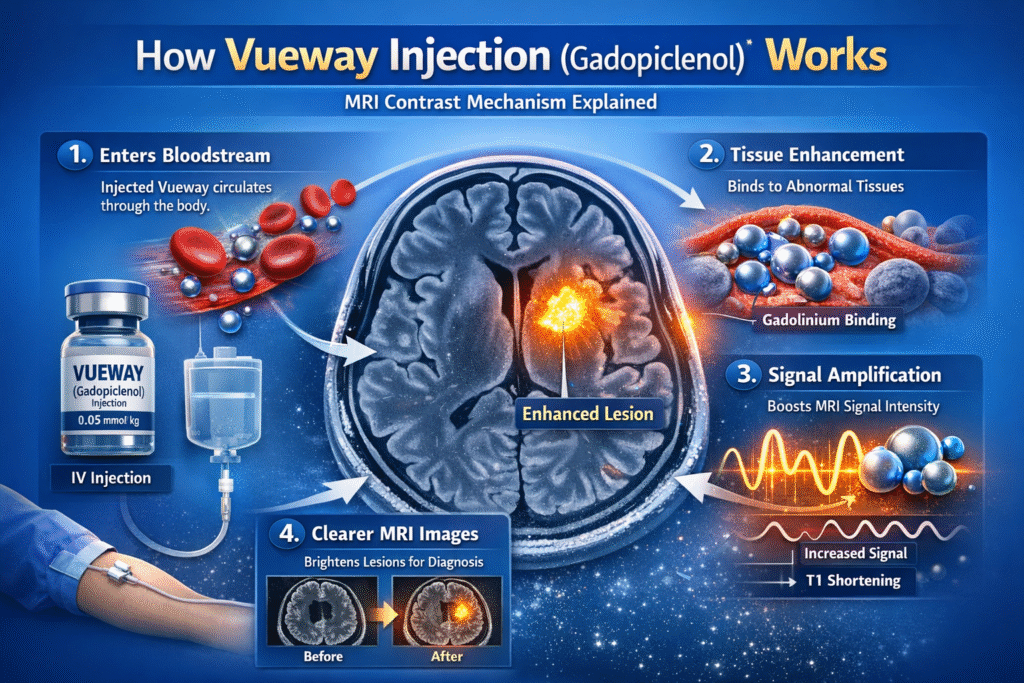
Step-by-Step Mechanism
- Intravenous Administration
During MRI preparation, vueway is administered intravenously so that the contrast agent circulates through the bloodstream.
- Distribution in Extracellular Space
After administration, vueway injection distributes rapidly into extracellular fluid throughout the body.
- Magnetic Signal Enhancement
The gadolinium ion in vueway has strong paramagnetic properties. This shortens the T1 relaxation time of nearby hydrogen protons.
- Increased Image Contrast
By altering relaxation times, vueway injection increases signal intensity on T1-weighted MRI images.
- Improved Lesion Visibility
Areas with abnormal vascularity or disrupted blood-brain barriers accumulate more vueway , making lesions appear brighter and easier to detect.
Because of its high relaxivity, vueway injection can produce strong imaging signals even at a reduced dose.
Clinical Uses of Vueway
Vueway injection is used during MRI examinations to improve the visualization of lesions and abnormalities.
Major Diagnostic Uses
Radiologists use vueway to enhance imaging in the following areas:
Brain Imaging
- Detection of tumors
- Multiple sclerosis lesions
- Brain metastases
- Inflammatory diseases
Spinal Imaging
- Spinal tumors
- Disc abnormalities
- Inflammatory spinal conditions
Whole Body Imaging
- Liver lesions
- Soft tissue tumors
- Vascular abnormalities
- Metastatic cancer detection
Because of its strong imaging capability, vueway injection helps physicians make more accurate diagnoses.
Dosage and Administration
The recommended dosage of vueway is lower than many traditional gadolinium contrast agents.
Standard Dose
The typical recommended dose of vueway is:
0.05 mmol/kg body weight
This is half the dose used by many conventional GBCAs.
Administration Method
Vueway injection is administered:
- Intravenously
- As a bolus injection
- Immediately before MRI scanning
Pediatric Use
One major advantage of vueway injection is its approval for patients aged 2 years and older, making it suitable for pediatric MRI imaging.
FDA Approval of Vueway
The FDA approval of vueway followed extensive clinical trials evaluating its imaging performance and safety.
Clinical Trial Highlights
Clinical studies compared vueway with other gadolinium contrast agents.
Results showed that vueway provided:
- Comparable or superior lesion detection
- Stronger MRI signal intensity
- Effective imaging at reduced dosage
Based on these results, regulatory authorities granted approval for vueway for use in MRI imaging of the brain, spine, and body.
The approval confirms that vueway meets strict standards for diagnostic accuracy and patient safety.
Advantages of Vueway
There are several advantages associated with vueway compared with older contrast agents.
Key Benefits
Reduced Gadolinium Exposure
Because vueway injection works at half the standard dose, patients receive less gadolinium overall.
High Imaging Quality
The high relaxivity of vueway injection produces strong MRI signals and clearer lesion detection.
Macrocyclic Stability
The macrocyclic structure of vueway injection tightly binds gadolinium, reducing the risk of gadolinium dissociation.
Pediatric Approval
Unlike some contrast agents, vueway injection is approved for use in children aged two years and older.
These advantages make vueway injection a preferred choice in many MRI diagnostic settings.
Side Effects of Vueway
Most patients tolerate vueway well, but some side effects may occur.
Common Side Effects
- Headache
- Nausea
- Injection site discomfort
- Mild dizziness
Less Common Side Effects
- Allergic reactions
- Skin rash
- Vomiting
- Fatigue
Rare but Serious Reactions
Rare complications associated with vueway may include:
- Severe allergic reactions
- Hypersensitivity reactions
- Nephrogenic systemic fibrosis in patients with severe kidney disease
Healthcare providers monitor patients carefully when administering vueway to minimize risks.
Drug Interactions of Vueway
Drug interactions with vueway injection are relatively uncommon because it is a diagnostic contrast agent rather than a therapeutic medication.
However, certain clinical factors should still be considered.
Potential Interaction Considerations
Nephrotoxic Drugs
Patients taking nephrotoxic medications should be monitored when receiving vueway, especially if kidney function is compromised.
Other Contrast Agents
Using multiple contrast agents in a short time frame may increase the risk of adverse reactions.
Kidney Function Tests
Laboratory tests used to measure kidney function may influence decisions regarding vueway administration.
Healthcare providers evaluate medical history before administering vueway injection.
Safety Precautions
Although vueway injection has a strong safety profile, some precautions should be taken.
Kidney Disease
Patients with severe kidney impairment may require special evaluation before receiving vueway injection.
Allergic History
Individuals with previous contrast agent reactions should inform healthcare providers before receiving vueway injection.
Pregnancy
The use of vueway injection during pregnancy should only occur if clearly necessary and recommended by a physician.
Future Developments in MRI Contrast Agents
The development of vueway represents an important step forward in imaging technology.
Future research may focus on:
- Even lower gadolinium doses
- Advanced targeted imaging agents
- Safer contrast agents for high-risk patients
- Improved MRI diagnostic accuracy
As imaging technology continues to evolve, agents like vueway will likely play a key role in next-generation diagnostic medicine.
Conclusion
Vueway is an innovative macrocyclic gadolinium-based contrast agent that improves MRI imaging of lesions in the brain, spine, and body. By using the active compound gadopiclenol, this contrast agent provides excellent imaging quality while requiring only half the standard gadolinium dose.
Its high relaxivity, macrocyclic stability, and pediatric approval make vueway a valuable diagnostic tool for radiologists and healthcare professionals. The ability to enhance MRI images while minimizing gadolinium exposure represents a significant advancement in medical imaging.
Although vueway injection is generally well tolerated, healthcare providers must consider patient history, kidney function, and potential side effects before administration.
As MRI technology continues to advance, vueway injection is expected to remain an important component of modern diagnostic imaging.