

Table of Contents
Introduction: A Landmark Decision for Cardiovascular Health
The landscape of cardiovascular medicine has been fundamentally reshaped by a recent, pivotal announcement: the Myqorzo FDA approval . This decision by the U.S. Food and Drug Administration (FDA) grants market access to Myqorzo (aficamten), a novel cardiac myosin inhibitor developed by Cytokinetics, for the treatment of adults suffering from symptomatic obstructive hypertrophic cardiomyopathy (oHCM).
For a patient population long underserved by targeted therapies, the Myqorzo FDA approval represents a profound shift from managing symptoms to addressing the underlying cause of this debilitating, inherited heart condition. This comprehensive analysis delves into the significance of this regulatory milestone, the science that underpins the drug’s success, and the implications for the future of oHCM care.
Understanding Obstructive Hypertrophic Cardiomyopathy (oHCM)
Hypertrophic Cardiomyopathy (HCM) is the most common inherited heart disease, affecting approximately one in 500 people globally . It is characterized by the thickening of the heart muscle, particularly the left ventricle. In the obstructive form, oHCM, this thickening causes a blockage (obstruction) in the outflow tract—the path blood takes as it leaves the heart. This obstruction forces the heart to work harder to pump blood, leading to a cascade of debilitating symptoms and complications.
Patients with symptomatic oHCM often experience severe shortness of breath (dyspnea), chest pain, fatigue, and palpitations, which severely limit their functional capacity and quality of life. In severe cases, oHCM can lead to atrial fibrillation, heart failure, and sudden cardiac death. Historically, treatment options have been limited to non-specific medications like beta-blockers and calcium channel blockers, or invasive procedures such as septal myectomy or alcohol septal ablation. The Myqorzo FDA approval provides a much-needed, targeted pharmacological alternative that directly addresses the molecular pathology of the disease.
The Science Behind Myqorzo (Aficamten): Mechanism of Action (MOA)
The Myqorzo drug’s sophisticated and targeted Mechanism of Action (MOA) is a direct result of the clinical success. Myqorzo, or aficamten, is classified as a next-generation, selective cardiac myosin inhibitor. Its function is to address the fundamental molecular defect in oHCM: the hypercontractility of the heart muscle.
In patients with oHCM, genetic mutations cause an excessive number of myosin heads—the motor proteins responsible for muscle contraction—to be in an active, force-producing state. This leads to the characteristic hyperdynamic contraction and the subsequent thickening of the left ventricular wall. Myqorzo works by selectively and reversibly binding to the cardiac myosin head. This binding stabilizes the myosin in a state where it is less likely to interact with actin, effectively reducing the number of active, force-generating cross-bridges.
By modulating this hypercontractility, Myqorzo achieves two critical therapeutic effects: it reduces the excessive force generation of the heart muscle and decreases the left ventricular outflow tract (LVOT) obstruction, which is the mechanical bottleneck in oHCM. This targeted action improves the heart’s ability to relax and fill with blood, leading to improved hemodynamics and functional capacity. The precision of this MOA is the core reason this regulatory milestone is considered a landmark event, offering a true disease-modifying approach rather than just symptomatic relief. This targeted intervention is a significant advancement in the treatment paradigm for oHCM.
Detailed FDA Approval Information
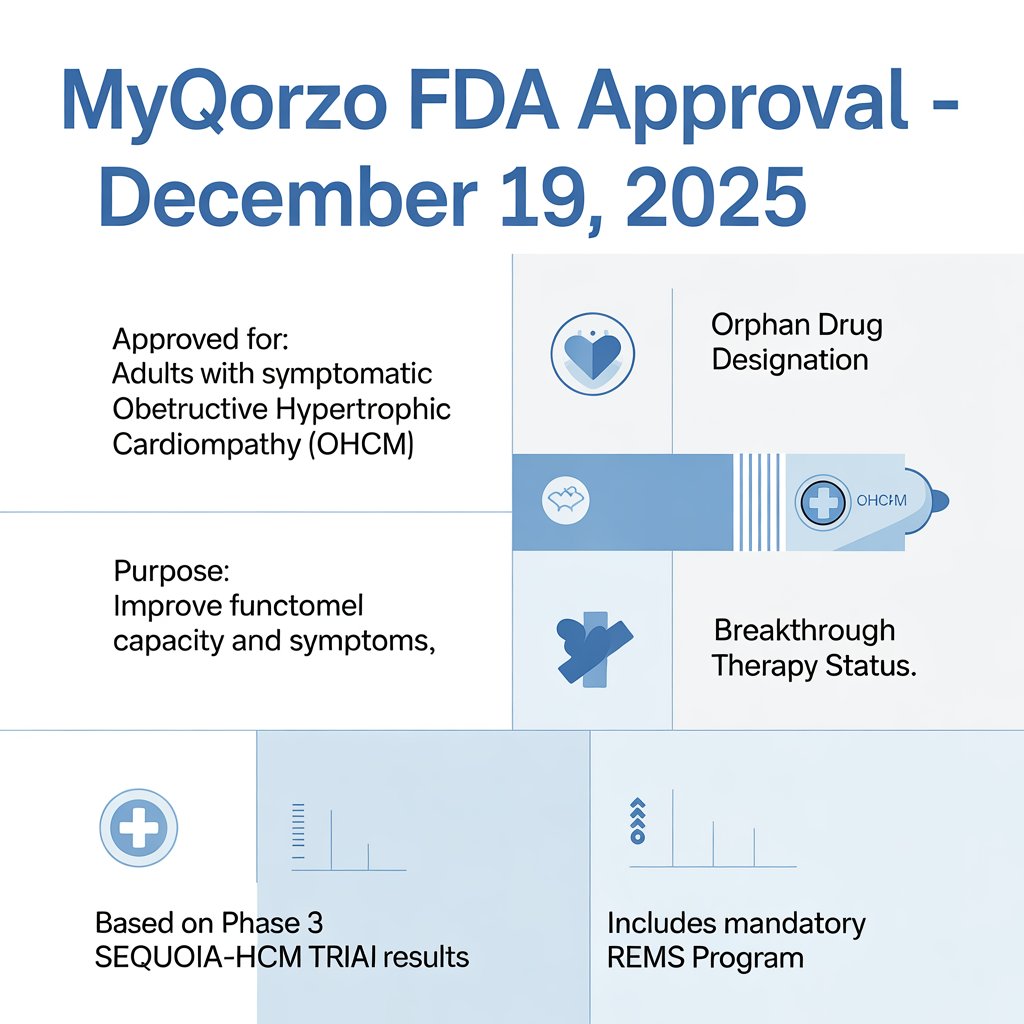
The Myqorzo FDA approval was granted on December 19, 2025, to Cytokinetics for the treatment of adults with symptomatic obstructive hypertrophic cardiomyopathy (oHCM) to improve functional capacity and symptoms. The approval was expedited by the drug’s prior designation as an Orphan Drug and a Breakthrough Therapy, reflecting the high unmet medical need in this patient population. The Myqorzo FDA approval decision was based on the robust and compelling data from the Phase 3 SEQUOIA-HCM trial, which demonstrated significant clinical benefit.
The full prescribing information, released shortly after the regulatory decision, details the drug’s use, dosage, and critical safety information, including the mandatory Risk Evaluation and Mitigation Strategy (REMS) program. The drug’s clearance is a major regulatory achievement, providing a new standard of care.
The Pivotal SEQUOIA-HCM Trial: The Foundation for Myqorzo FDA Approval
The foundation for the Myqorzo FDA approval rests squarely on the robust data generated from the Phase 3 SEQUOIA-HCM clinical trial . This was a global, randomized, double-blind, placebo-controlled study that enrolled 282 adults with symptomatic oHCM. The trial was designed to evaluate the efficacy and safety of Myqorzo over a 24-week period. The primary endpoint was the change in peak oxygen uptake (pVO2), a gold-standard measure of exercise capacity, as assessed by cardiopulmonary exercise testing (CPET).
The results were overwhelmingly positive and statistically significant. Patients receiving Myqorzo demonstrated a mean increase in pVO2 of 1.8 mL/kg/min from baseline, compared to virtually no change (0.0 mL/kg/min) in the placebo group. The least square mean difference between the two groups was a highly significant 1.74 mL/kg/min (p=0.000002). This improvement in pVO2 is clinically meaningful, translating directly to a patient’s ability to perform daily activities with less fatigue and shortness of breath. The success of this trial was the critical factor that paved the way for the landmark regulatory clearance.
Key Efficacy and Safety Data from the Trial
Beyond the primary endpoint, the SEQUOIA-HCM trial provided compelling evidence of the drug’s broad clinical benefit, further solidifying the case for the Myqorzo FDA approval.
Improvement in Symptoms and Functional Class
A key secondary endpoint focused on the improvement in the New York Heart Association (NYHA) functional class, a standard measure of physical activity limitation. The trial showed that 59% of participants treated with Myqorzo experienced an improvement of at least one NYHA class, compared to only 24% of those on placebo . This dramatic difference underscores the drug’s ability to significantly improve the daily lives and functional status of oHCM patients. Furthermore, the treatment effect was consistent across all prespecified subgroups, including patients already taking beta-blockers, demonstrating the drug’s broad applicability.
Safety Profile, Side Effects, and the REMS Program
The drug’s regulatory clearance is accompanied by a comprehensive safety profile, which includes the Myqorzo FDA approval most stringent caution: a Boxed Warning for the risk of heart failure due to systolic dysfunction. As a cardiac myosin inhibitor, Myqorzo reduces the heart’s contractility, and an excessive reduction in the left ventricular ejection fraction (LVEF) can precipitate heart failure .
To manage this critical risk, the FDA has mandated that Myqorzo be distributed solely through a restricted program: the Myqorzo Risk Evaluation and Mitigation Strategy (REMS). This program is central to the safe use of the drug and requires mandatory, periodic echocardiogram assessments to monitor LVEF. Dosing guidelines are strict: Myqorzo initiation is not recommended if LVEF is below 55%, and the dose must be reduced or interrupted if LVEF falls below specific thresholds. The REMS ensures that only certified healthcare providers and pharmacies are involved in the prescribing and dispensing process.
In terms of common side effects, the Phase 3 SEQUOIA-HCM trial provided a clear picture. The most frequently reported adverse reaction, occurring in more than 5% of patients and more often than in the placebo group, was Hypertension (8% vs 2%). Other treatment-emergent serious adverse events were less common in the Myqorzo group (5.6%) than in the placebo group (9.3%). The overall safety data from the trial was reassuring, suggesting that with adherence to the REMS monitoring protocol, the drug offers a favorable risk-benefit profile following the Myqorzo clearance.
Drug Interactions: A Critical Consideration
A key aspect of the Myqorzo FDA approval and its safe use is the management of potential drug interactions. Myqorzo is primarily metabolized by the cytochrome P450 (CYP) enzyme system, specifically CYP2C9 and, to a lesser extent, CYP3A and CYP2D6. This metabolic pathway makes Myqorzo susceptible to interactions with other medications that either inhibit or induce these enzymes.
Strong CYP Inhibitors: Co-administration with strong inhibitors of these enzymes can significantly increase the concentration of Myqorzo in the bloodstream, thereby increasing the risk of excessive LVEF reduction and heart failure. For instance, strong CYP2C9 inhibitors (e.g., fluconazole, amiodarone) and strong CYP3A inhibitors (e.g., clarithromycin, itraconazole) must be used with extreme caution, and dose adjustments or alternative therapies may be necessary.
Strong CYP Inducers: Conversely, medications that are strong inducers of these enzymes, such as rifampin or St. John’s wort, can decrease the concentration of Myqorzo, leading to a loss of therapeutic effect and a potential worsening of oHCM symptoms. The prescribing information explicitly warns against the use of certain strong inducers.
The relatively less complex drug-drug interaction profile of Myqorzo, compared to its competitor, is considered a practical advantage, simplifying the prescribing process for physicians and enhancing the real-world usability of the drug after its FDA approval. This ease of management is a major benefit for patients on multiple medications.
The Competitive Landscape: Myqorzo vs. Camzyos
The Myqorzo FDA approval sets the stage for a significant market competition in the oHCM space. Myqorzo is the second cardiac myosin inhibitor to receive FDA approval, following Bristol Myers Squibb’s Camzyos (mavacamten), which was approved in 2022. While both drugs share the same mechanism of action, analysts and clinicians have noted subtle but important differences that could influence prescribing patterns .
A key differentiator lies in the drugs’ pharmacokinetic profiles, specifically their half-lives. Mavacamten has a longer half-life (6–9 days) compared to aficamten (3–4 days) . This shorter half-life for Myqorzo offers a practical advantage: it allows for more rapid dose titration and a quicker washout period if a patient experiences a significant drop in LVEF. This “convenience factor” is crucial in a REMS-mandated monitoring environment, potentially making the management of Myqorzo less burdensome for both patients and physicians. The less complex drug-drug interaction profile of Myqorzo is also a significant advantage, further simplifying the prescribing process and enhancing the real-world usability following the Myqorzo FDA approval.
The commercial battle between these two therapies will be closely watched, but the ultimate winner is the patient community, which now has two targeted, disease-modifying options. The Myqorzo FDA approval ensures that physicians have a choice, allowing for more personalized treatment decisions based on a patient’s specific clinical profile and co-morbidities.
Conclusion: The Future of oHCM Treatment
The Myqorzo FDA approval is more than just a regulatory formality; it is a testament to decades of research into the molecular underpinnings of hypertrophic cardiomyopathy. By providing a targeted therapy that significantly improves exercise capacity and symptoms, Myqorzo offers new hope and a dramatically improved quality of life for adults living with symptomatic oHCM.
Cytokinetics anticipates that Myqorzo will be commercially available in the U.S. in the second half of January 2026, supported by a comprehensive patient program, “Myqorzo & You™” . The successful Myqorzo FDA approval not only validates Cytokinetics’ long-standing commitment to cardiovascular science but also solidifies the role of cardiac myosin inhibitors as the standard of care for this complex, inherited disease. The medical community eagerly anticipates the long-term impact of this drug, which promises to redefine the therapeutic goals for oHCM patients worldwide. The significance of the Myqorzo FDA approval cannot be overstated.