
Table of Contents
Introduction
In the fast-paced world of cancer treatment, Imdelltra (tarlatamab-DLE) is emerging as a groundbreaking immunotherapy. Approved by the FDA for patients with extensive-stage small cell lung cancer (ES-SCLC) that has progressed after platinum-based chemotherapy, Imdelltra offers a new lifeline.
However, beyond the clinical data, there is an essential operational aspect – the Imdelltra J code – that ensures accurate billing and reimbursement. This article covers all aspects of Imdelltra, from its mechanism of action to its administration, safety, and important J-code (J9026) for healthcare providers and pharmacy professionals.
What Is Imdelltra?
Imdelltra (tarlatamab-dlle) is the first delta-like ligand 3 (DLL3)–targeting bispecific T-cell engager (BiTE®) therapy developed by Amgen.
Mechanism of Action
- Imdelltra binds to DLL3 on tumor cells and CD3 on T cells, enabling immune-mediated killing of cancer cells.
- DLL3 is expressed in over 85–96% of SCLC tumors, but minimally in normal tissues — making it an ideal target.
- By engaging the patient’s immune system directly, Imdelltra provides targeted destruction of cancer cells while limiting collateral damage.
FDA Approval
Imdelltra received accelerated FDA approval on May 16, 2024 for adult patients with ES-SCLC after progression on platinum-based chemotherapy. This approval made it the first and only DLL3-targeted therapy for this patient population.
Clinical Evidence Supporting Imdelltra
The DeLLphi-301 trial served as the pivotal Phase 2 study leading to Imdelltra’s approval.
- Objective Response Rate (ORR): 40%
- Median Duration of Response: 9.7 months
- Median Overall Survival: 14.3 months
Further validation came from DeLLphi-304 (Phase 3), which reported a 40% reduction in the risk of death compared to chemotherapy, with overall survival improvement from 8.3 months to 13.6 months.
These outcomes established Imdelltra as a major therapeutic advancement in relapsed SCLC.
Administration and Dosing
Dosing Schedule
Imdelltra is given as an IV infusion under the supervision of a trained healthcare professional. The dosing follows a step-up regimen to mitigate cytokine release syndrome (CRS):
| Cycle | Day | Dose |
| 1 | Day 1 | 1 mg |
| 1 | Day 8 | 10 mg |
| 1 | Day 15 | 10 mg |
| Every 2 weeks thereafter | — | 10 mg |
Patients must remain under medical observation for 48 hours after initial infusions (Cycle 1 Day 1 and Day 8).
Safety and Warnings
Imdelltra includes boxed warnings for serious or life-threatening toxicities:
- Cytokine Release Syndrome (CRS)
- Neurologic Toxicity, including immune effector cell–associated neurotoxicity syndrome (ICANS)
Other notable adverse effects include:
- Fatigue (51%)
- Fever (36%)
- Dysgeusia (36%)
- Decreased appetite (34%)
- Constipation (30%)
- Anemia (27%)
Precautions:
- Monitor complete blood counts and liver enzymes
- Educate patients on symptoms of CRS or neurological changes
- Use contraception due to embryo-fetal risk
Understanding the Imdelltra J Code
What Is a J-Code?
In U.S. medical billing, J-codes are part of the Healthcare Common Procedure Coding System (HCPCS), representing injectable or infusion drugs.
Each code corresponds to a specific drug and dose for billing purposes under Medicare, Medicaid, and private payers.
The Imdelltra J Code Explained
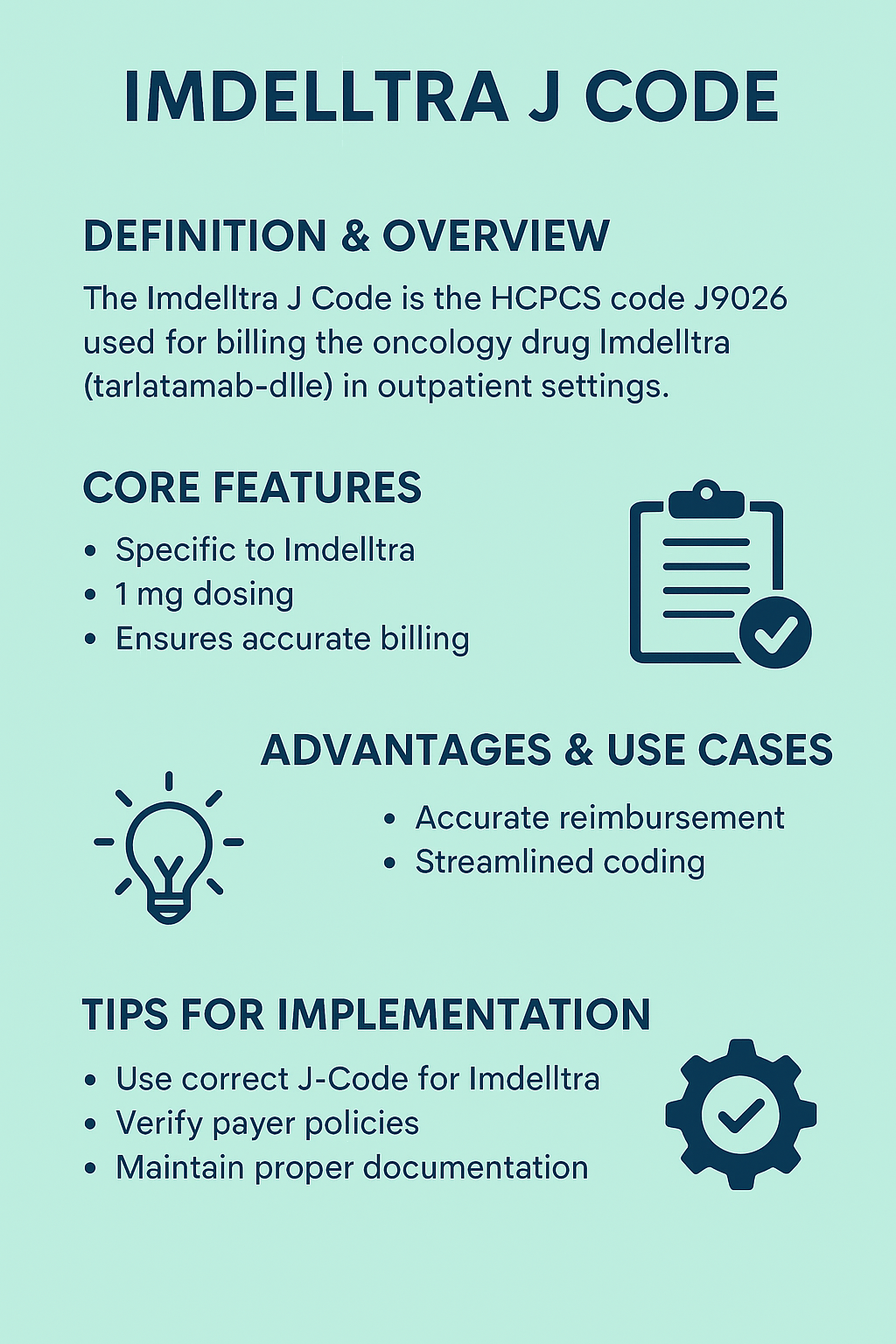
The Imdelltra J Code is J9026, which corresponds to:
J9026 – Injection, tarlatamab-dlle, 1 mg
This code identifies Imdelltra for reimbursement and ensures precise billing in outpatient oncology or infusion settings.
Why the Imdelltra J Code Matters
- Accurate Reimbursement: Prevents underpayment or denials from payers.
- Compliance: Ensures documentation matches FDA indication and HCPCS code.
- Workflow Efficiency: Helps pharmacy teams coordinate drug preparation and billing.
- Audit Readiness: Reduces risk of claim rejection or financial discrepancies.
Key Steps for Providers
- Verify the correct dose and vial size (1 mg or 10 mg).
- Use J9026 for Imdelltra when billing.
- Document indication (ES-SCLC after platinum therapy).
- Follow payer-specific coverage policies and precertification rules.
- Keep infusion safety documentation updated.
Pharmacy & Quality Assurance (QA) Perspective
Inventory Management
- Maintain both 1 mg and 10 mg vials for step-up dosing.
- Store under required temperature and humidity conditions.
- Ensure traceability of lot numbers and compounding details.
QA & Safety Oversight
- Verify CRS and ICANS management protocols.
- Review labs before each infusion.
- Maintain real-world adverse event tracking.
- Ensure staff training on emergency management of infusion reactions.
Billing and Coding QA
- Double-check Imdelltra J Code (J9026) for each claim.
- Confirm documentation aligns with payer policy (e.g., Aetna, CMS).
- Review reimbursement rates and patient assistance program eligibility.
Practical Example
A 60-year-old patient with ES-SCLC who progressed after platinum therapy begins Imdelltra.
- Step-up dosing follows the standard 1 mg → 10 mg → 10 mg pattern.
- Pharmacy prepares infusion using two vial strengths.
- Billing team uses Imdelltra J Code J9026 (per mg).
- Coverage is confirmed through prior authorization.
- Documentation includes CRS monitoring and safety plan.
This ensures clinical compliance and smooth reimbursement under payer policies.
Conclusion
Imdelltra (tarlatamab-DLE) is a major leap forward for patients with relapsed small cell lung cancer. Its dual-binding immunomodulatory mechanism offers real survival benefits where alternatives were limited.
However, understanding its operational and reimbursement aspects—particularly Imdelltra J codes (J9026)—is important for every oncology and pharmacy professional.