
Table of Contents
Introduction: Understanding How Long Does Lidocaine Injection Last in Skin
If you’ve ever had minor surgery, a skin biopsy, a tattoo, or a dental procedure, you’ve probably experienced the numbing effects of lidocaine. It’s the most widely used local anesthetic in medicine today. But a common question patients and doctors ask is – how long does lidocaine injection last in skin?
The answer depends on several factors, such as the dose, the injection site, the presence of vasoconstrictors, and the person’s skin and metabolism. On average, lidocaine provides numbness for 30 minutes to 2 hours, but in certain situations it can last even longer.
In this article, we’ll explore how lidocaine works, how long does lidocaine injection last in skin , and how to safely maintain its effects,Let’s find out.
What Is Lidocaine?
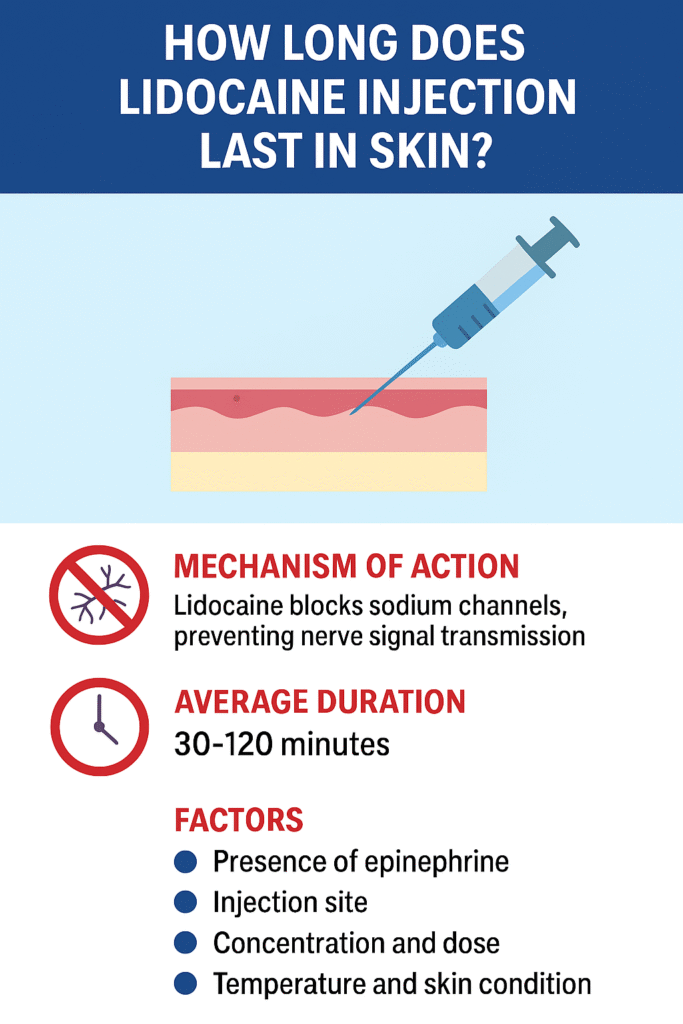
Lidocaine is a local anesthetic and antiarrhythmic agent that works by blocking sodium channels in nerve membranes. It prevents pain signals from reaching the brain, causing local numbness where it is applied or injected.
It was first developed in the 1940s and remains the gold-standard anesthetic due to its rapid onset, predictable duration, and excellent safety profile.
Common Forms of Lidocaine:
- Lidocaine Injection (1% or 2%) – for skin infiltration and minor surgical procedures.
- Lidocaine Creams/Gels (2–5%) – used for cosmetic procedures, tattooing, and waxing.
- Lidocaine Patches (5%) – for chronic pain conditions like postherpetic neuralgia.
- Lidocaine with Epinephrine – to prolong numbness and reduce bleeding.
Mechanism of Action: How Lidocaine Works in Skin
To understand how long does lidocaine injection last in skin, it helps to know how it works.
When lidocaine is injected into the skin:
1. It enters the nerve endings in the local tissues.
2. It blocks sodium ion channels, preventing nerve cells from generating and transmitting pain impulses.
3. This causes a temporary loss of sensation (numbness) in that specific area.
4. Over time, the drug is absorbed into the bloodstream and metabolized by the liver, gradually returning nerve activity to normal.
Onset Time:
- 1 to 3 minutes after injection for infiltration anesthesia.
Peak Effect:
- Within 5 to 10 minutes after injection.
Duration:
- 30 to 120 minutes depending on the dose and conditions.
So, How Long Does Lidocaine Injection Last in Skin?
Here’s the core answer to our main question — how long does lidocaine injection last in skin?
| Formulation | Average Duration (Skin) | With Epinephrine |
| 1% Lidocaine | 30–60 minutes | 1–2 hours |
| 2% Lidocaine | 45–90 minutes | 2–4 hours |
| Lidocaine with Epinephrine (1:100,000) | 1–2 hours | 3–6 hours |
| Lidocaine Cream (topical) | 20–40 minutes | — |
| Lidocaine Patch | Up to 12 hours | — |
So, on average, lidocaine injection lasts between 30 minutes and 2 hours in skin, and up to 4–6 hours when combined with epinephrine.
This wide variation depends on tissue type, blood flow, and concentration used.
Factors That Influence How Long Does Lidocaine Last in Skin
Several factors affect how long does lidocaine injection last in skin. Understanding this helps medical professionals optimize its effect and accurately predict the duration for patients.
1. Presence of Epinephrine
The addition of epinephrine (a vasoconstrictor) causes blood vessels to constrict, reducing the absorption of lidocaine into the bloodstream.
➡️ Result: Longer numbness and less bleeding during the procedure.
2. Injection site
• Highly vascularized areas (face, scalp) → shorter duration (30-60 minutes).
• Less vascularized areas (hands, thighs) → longer duration (up to 2 hours).
• Mucous membranes → faster onset but less effect.
3. Concentration and dosage
Higher concentrations than 1% solutions (2%) = longer duration of anesthesia.
However, higher doses may increase the risk of systemic toxicity.
4. Individual metabolism
People with rapid liver metabolism or high blood circulation clear lidocaine faster, reducing its activity.
5. Temperature and skin condition
Warm skin increases absorption and decreases duration; cold skin or damaged areas delay absorption.
6. Use of topical versus injectable lidocaine
Injectable forms penetrate deeper and last longer than topical gels or creams.
Clinical Uses of Lidocaine in Skin Procedures
Lidocaine injection is indispensable in dermatology, surgery, and cosmetic medicine. It ensures painless procedures and improves patient comfort.
Common Dermatological and Cosmetic Uses:
- Skin Biopsies – for painless tissue sampling.
- Minor Surgical Excision – removal of cysts, moles, and warts.
- Laser Treatments & Tattooing – reduces discomfort during sessions.
- Cosmetic Fillers & Microneedling – improves tolerance and recovery.
- Liposuction (Tumescent Technique) – large doses of diluted lidocaine provide anesthesia and vasoconstriction.
- Wound Suturing & Cleaning – ensures pain-free stitching.
In all these, understanding how long does lidocaine injection last in skin helps practitioners plan duration, dosage, and timing of reapplication.
Comparison: Lidocaine vs Other Local Anesthetics
| Drug | Onset Time | Duration (Skin) | Toxicity Risk |
| Lidocaine | 1–3 mins | 1–2 hrs | Moderate |
| Bupivacaine | 5–10 mins | 3–8 hrs | Higher (cardiac) |
| Mepivacaine | 2–4 mins | 1–3 hrs | Moderate |
| Procaine | 2–5 mins | 30–60 mins | Low |
| Articaine | 1–3 mins | 1–2 hrs | Moderate |
Conclusion:
Lidocaine provides the best balance between rapid onset and medium duration, making it ideal for most skin procedures.
How to Make Lidocaine’s Effect Last Longer Safely
If you’re wondering how long does lidocaine injection last in skin, you might also want to know how to extend its effect safely.
Here are proven methods:
- Use Lidocaine with Epinephrine – prolongs effect 2–3× longer.
- Inject Precisely at the Target Area – proper infiltration ensures uniform numbness.
- Avoid Excessive Massage Post-Injection – this disperses lidocaine faster.
- Use Cold Compress Before Procedure – reduces blood flow, keeping drug local longer.
- Optimal pH Buffers – slightly alkaline lidocaine works faster and lasts longer.
Safety, Side Effects & Precautions
Lidocaine is generally safe when used in recommended doses, but systemic absorption or overdose can cause side effects.
Common Local Reactions:
- Mild redness or swelling
- Temporary burning or tingling
- Numbness extending beyond target area
Rare but Serious Side Effects:
- CNS symptoms: Dizziness, confusion, seizures
- Cardiac effects: Bradycardia, arrhythmias, hypotension
- Allergic reactions: Rash, itching, swelling
Safety Tips:
- Always follow maximum dosage guidelines (≤ 5 mg/kg plain, ≤ 7 mg/kg with epinephrine).
- Avoid injecting into infected or inflamed skin.
- Be cautious in liver disease, heart block, or elderly patients.
Pharmacokinetics: How the Body Processes Lidocaine
Once injected, lidocaine:
- Distributes rapidly into highly perfused tissues (heart, brain, skin).
- Metabolized by the liver’s CYP1A2 and CYP3A4 enzymes into active metabolites.
- Excreted by kidneys (mostly as metabolites).
- Half-life: Approximately 1.5 to 2 hours.
This aligns with its clinical duration in skin, reinforcing why lidocaine injection lasts 30–120 minutes.
Lidocaine in Aesthetic & Cosmetic Treatments
The use of lidocaine in cosmetic dermatology has skyrocketed. From tattoo numbing to lip fillers, it ensures pain-free sessions.
Popular Cosmetic Procedures Using Lidocaine:
- Botox and dermal fillers
- Tattoo removal or microblading
- Chemical peels and laser resurfacing
- PRP (Platelet-Rich Plasma) injections
Knowing how long lidocaine injection lasts in skin helps aestheticians plan sessions effectively, minimizing discomfort and downtime.
Fun Fact:
Did you know? Lidocaine is listed on the World Health Organization’s List of Essential Medicines due to its high efficacy and safety.
Quick Summary Table
| Aspect | Details |
| Mechanism | Sodium channel blocker – prevents nerve signal conduction |
| Onset Time | 1–3 minutes |
| Average Duration (Skin) | 30 min – 2 hours |
| With Epinephrine | 3–6 hours |
| Uses | Local anesthesia for dermatologic and cosmetic procedures |
| Maximum Dose | 5 mg/kg (plain), 7 mg/kg (with epinephrine) |
| Metabolism | Liver (CYP1A2, CYP3A4) |
| Excretion | Renal |
| Safety | Excellent when used correctly |
Conclusion: Key Takeaways
To summarize, the answer to how long does lidocaine injection last in skin depends on dose, formulation, injection site, and individual metabolism.
Typically:
- Plain lidocaine lasts 30 to 120 minutes.
- Lidocaine with epinephrine extends up to 6 hours.
Its fast onset, reliable anesthesia, and safety make it a trusted choice for dermatologists, dentists, and cosmetic practitioners worldwide.
So, whether you’re a medical professional or someone preparing for a procedure, knowing how long does lidocaine injection last in skin helps ensure comfort, safety, and peace of mind.
1 thought on “How Long Does Lidocaine Injection Last in Skin? Duration, Factors & Safety Explained”