
Table of Contents
Introduction
Autoimmune disorders continue to increase worldwide, affecting millions of individuals with diseases such as myasthenia gravis (MG), immune thrombocytopenia (ITP), CIDP, and pemphigus. Traditional treatments such as corticosteroids, immunosuppressant’s, and biologics often result in relapses or serious side effects.
In 2025, efgartigimod alfa-fcab has emerged as a game-changing biologic that is reshaping how healthcare professionals approach antibody-mediated autoimmune diseases. Its unique mechanism of reducing pathogenic IgG antibodies without suppressing overall immunity makes it a highly targeted and well-tolerated therapy option.
This comprehensive guide explores everything you need to know about egartigimod alfa-fcab – from its mechanism of action and indications to dosage, clinical benefits, safety profile, cost considerations, and future potential in autoimmune disease treatment.
What is Efgartigimod Alfa-Fcab?
Efgartigimod alfa-Fcab is a first-in-class engineered Fc fragment biologic that targets the neonatal Fc receptor (FcRN). By blocking FcRN, it accelerates the degradation of harmful IgG autoantibodies responsible for disease progression in autoimmune conditions.
Key Features:
• Engineered Fc fragment biologic (FCAB technology)
• Highly selective action on circulating IgG antibodies
• Maintains IgM and IgA levels – maintains immune defense
• Used for chronic autoimmune neuromuscular and hematological disorders
It offers a targeted approach with fewer systemic immunosuppressive effects compared to standard treatments.
How Does Efgartigimod Alfa-Fcab Work? (Mechanism of Action)
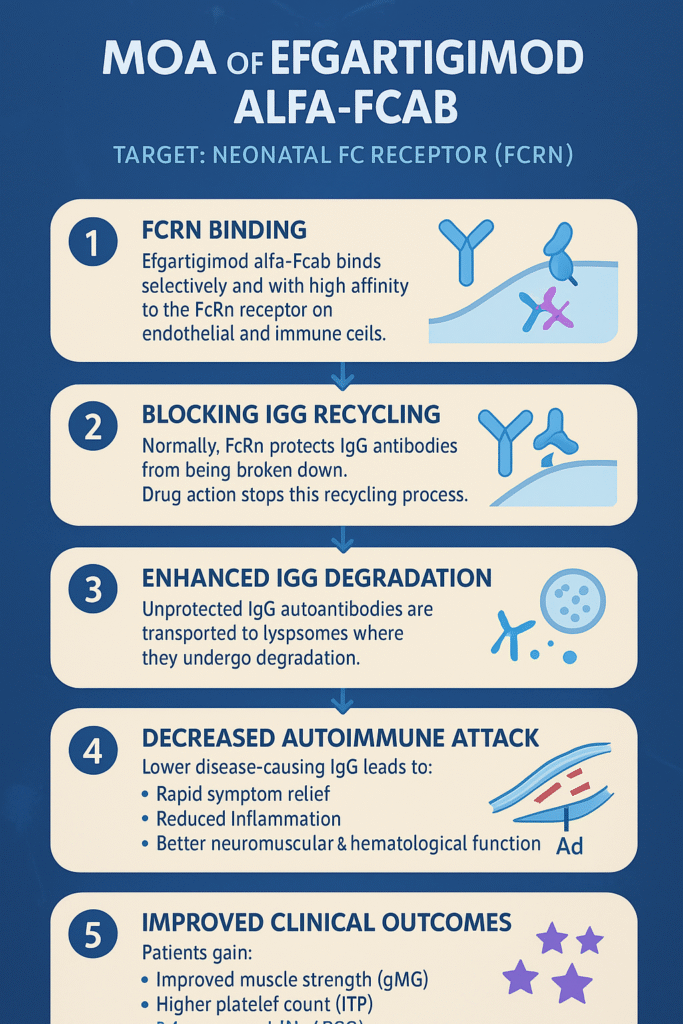
Healthy individuals rely on the FcRn receptor to protect antibodies from degradation and recycle them back into the bloodstream. However, in autoimmune diseases, pathogenic IgG autoantibodies cause muscle weakness, nerve damage, skin blistering, and organ dysfunction.
Efgartigimod alfa-fcab inhibits FcRn, resulting in:
- Binding to FcRn with high affinity
- Blocking IgG recycling
- Promoting lysosomal degradation of IgG
- Reducing plasma IgG levels including disease-causing autoantibodies
- Rapid clinical symptom improvement
Expected IgG Reduction:
- Up to 70% decline in total IgG levels within 1–2 weeks
- Sustained effect with cyclic dosing
This makes it one of the most precise biologics in managing autoimmune disorders.
Indications and Clinical Uses in 2025
As of 2025, efgartigimod alfa-fcab is used or under evaluation for several autoimmune diseases driven by IgG autoantibodies:
| Autoimmune Disorder | Status in 2025 | Key Benefits |
| Generalized Myasthenia Gravis (gMG) | Approved | Rapid improvement in muscle strength |
| Immune Thrombocytopenia (ITP) | Approved in many regions | Increased platelet count and reduced bleeding |
| Chronic Inflammatory Demyelinating Polyneuropathy (CIDP) | Under evaluation/Approved in some markets | Improvement in nerve conduction & mobility |
| Pemphigus Vulgaris | Clinical trials | Reduced flares and blister healing |
| Myositis & Lupus (SLE) | Studied in trials | Promising partial responses |
Thanks to its predictable action and tolerability, physicians increasingly prefer this therapy for long-term management of autoimmune disorders.
Administration & Dosage Forms
Efgartigimod alfa-fcab is available in two formulations to enhance treatment flexibility:
✔ Intravenous Infusion (IV)
✔ Subcutaneous Injection (SC) — self-administration option improving quality of life
General Dosage Schedule:
- 4 weekly doses per treatment cycle
- Repeat cycles based on clinical response and IgG rebound patterns
- SC formulation typically given weekly or every 2 weeks
The dosing strategy supports sustained autoimmune control without unnecessary exposure.
Clinical Benefits of Efgartigimod Alfa-Fcab
Patients and clinicians appreciate several advantages of this biologic:
🧬 Targeted IgG Reduction
Only pathogenic IgG is removed — not entire immune function.
⚡ Rapid Onset
Visible improvement within 1–2 weeks in gMG and ITP patients.
🔁 Long-Lasting Results
Symptom relief often continues between cycles, reducing treatment burden.
🛡️ Fewer Systemic Side Effects
Avoids long-term risks associated with steroids and immunosuppressants.
❤️ Improved Quality of Life
Better mobility, energy, and ability to perform daily tasks.
🌍 Patient-Friendly SC Option
Greater independence and fewer hospital visits.
Safety Profile: Is Efgartigimod Alfa-Fcab Safe?
Clinical trials and real-world data show a well-tolerated safety profile.
Common Side Effects:
- Headache
- Mild infections (like URTI)
- Injection site reactions (SC form)
- Fatigue
- Nausea
Rare But Important Concerns:
- Hypersensitivity reactions
- Increased infection risk with chronic use
Overall, balancing benefits vs. risks strongly favors continued or expanded use in autoimmune disorders.
Why Efgartigimod Alfa-Fcab is a Major Breakthrough in 2025
This drug represents a new era — precision autoimmunity therapy.
Traditional treatments:
❌ General immune suppression
❌ Higher infection & cancer risk
❌ Organ toxicity
❌ Slow clinical benefits
Efgartigimod alfa-fcab:
✔ Removes only harmful IgG
✔ Faster response time
✔ Better long-term tolerance
✔ Individualized cyclic therapy
It aligns with the global shift toward efficacy + safety + patient convenience.
Cost and Accessibility in 2025
Pricing varies by region, insurance, and formulation type. As with most advanced biologics, treatment is expensive, but reimbursement programs and patient assistance initiatives are expanding rapidly.
Factors impacting cost:
- Frequency of cycles
- Administration route (IV vs SC)
- Healthcare insurance support
As biosimilar competition emerges in future years, pricing may become more accessible.
Future Outlook: Expanding Use Beyond Current Indications
Researchers anticipate broader autoimmune applicability:
🔹 Multiple Sclerosis
🔹 Type 1 Diabetes (autoantibody modulation)
🔹 Autoimmune neuropathies
🔹 Rare antibody-driven dermatologic diseases
Additionally, ongoing research focuses on:
- Combination therapy with B-cell targeted biologics
- Personalized dosing based on IgG biomarkers
- Home-based SC care model with digital monitoring
With increasing physician adoption and patient success stories, demand for efgartigimod alfa-fcab is set to rise significantly in 2025 and beyond.
Conclusion
Efgartigimod alfa-fcab is a standout among the most promising biologics shaping autoimmune disorder management in 2025. Its precise targeting of IgG autoantibodies, rapid response rates, and improved safety profile represent a major step forward over traditional immunosuppression.
As research into additional diseases continues to grow worldwide and new self-administered options emerge, this therapy is poised to empower millions of people struggling with chronic autoimmune conditions – providing robust control and a better quality of life.