Table of Contents
Introduction
Lung and colorectal cancers are among the toughest cancers to treat globally. A major challenge in these cancers is a genetic mutation called KRAS G12C — long considered “undruggable.” But recent breakthroughs have made targeted treatment possible.
One of the most promising advancements is the combination of Krazati + Cetuximab, which delivers stronger and more durable responses against KRAS G12C–driven tumors.
This comprehensive, easy-to-understand guide will help you learn:
- What are Krazati and Cetuximab?
- Why this combination therapy is a breakthrough
- Krazati + Cetuximab mechanism of action (full step-by-step)
- Dosage, clinical benefits, side effects & safety monitoring
- Pharmacy-related insights and patient counseling points
What is KRAS G12C Mutation?
KRAS is one of the most common oncogenes in human cancers.
Key functions of KRAS:
- Regulates cell growth & survival
- Acts like a switch controlling signaling pathways
- Normal KRAS switches ON/OFF properly
But in KRAS G12C mutation:
- The KRAS switch is always ON
- Continuous cancer cell growth occurs
- Tumors become resistant to chemotherapy and targeted therapies
Most common cancers with KRAS G12C mutation:
| Cancer Type | Percentage with KRAS G12C Mutation |
| Non-Small Cell Lung Cancer (NSCLC) | 13–14% |
| Metastatic Colorectal Cancer (mCRC) | 3–4% |
| Pancreatic Cancer | ~2% |
This mutation leads to:
⚠ Aggressive tumor behavior
⚠ Poor prognosis
⚠ Limited treatment options
What is Krazati (Adagrasib)?
Krazati (Adagrasib) is a KRAS G12C inhibitor, approved for:
- Advanced/metastatic KRAS G12C mutated NSCLC
- KRAS G12C mutated metastatic colorectal cancer (when combined with cetuximab)
Key Characteristics
| Feature | Description |
| Drug Class | Targeted therapy (KRAS G12C inhibitor) |
| Administration | Oral tablet |
| Half-Life | Long — Ideal for continuous KRAS inhibition |
| BBB Penetration | Yes → Useful for brain metastases |
What is Cetuximab?
Cetuximab is an EGFR monoclonal antibody used in:
- Metastatic colorectal cancer
- Head & neck cancers
It works by:
✔ Blocking EGFR receptor
✔ Preventing growth signaling
✔ Enhancing immune response against tumor cells
Cetuximab helps overcome upregulated EGFR signaling, which is a key resistance mechanism in KRAS G12C therapy.
Why Combine Krazati + Cetuximab?
Here’s the key challenge:
When KRAS G12C inhibitors are used alone → Cancer cells adapt
🔁 EGFR pathway becomes hyperactive → Tumor resumes growth
➡ Solution: Combine KRAS G12C blockade with EGFR inhibition
This two-target strategy:
✔ Improves treatment response
✔ Prevents resistance development
✔ Prolongs cancer control
This makes Krazati + Cetuximab a powerful synergistic therapy.
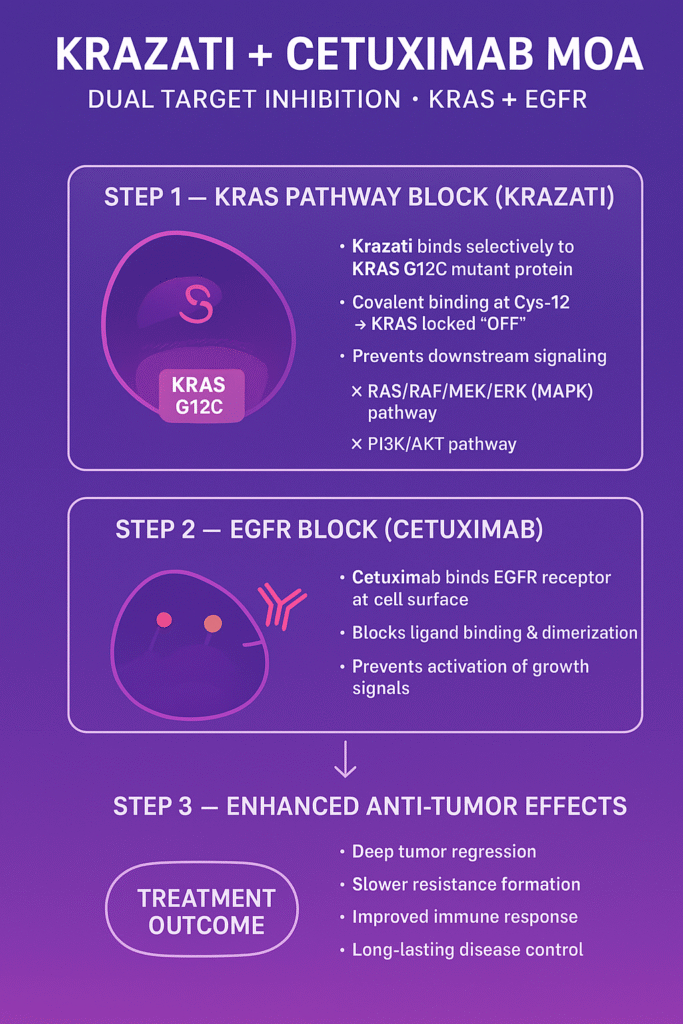
Krazati + Cetuximab Mechanism of Action (MOA)
Let’s simplify the science:
🔹 Step 1 — Krazati binds selectively to KRAS G12C mutation
- Krazati covalently attaches to cysteine-12 in KRAS G12C
- Locks KRAS in inactive GDP-bound state
- Stops downstream signaling:
🚫 MAPK Pathway
🚫 RAS/RAF/MEK/ERK
🚫 PI3K/AKT pathway
→ Cancer cell proliferation decreases
🔹 Step 2 — Cetuximab blocks EGFR signaling
- In KRAS mutated tumors:
- EGFR upregulation is a resistance escape pathway
- Cetuximab binds to EGFR receptors
- Prevents ligand attachment and receptor dimerization
→ Growth signals are stopped at the cell surface
🔹 Step 3 — Synergistic anti-tumor impact
Together they:
✔ Shut OFF both KRAS and EGFR signaling
✔ Overcome tumor resistance
✔ Enhance cancer cell death (apoptosis)
✔ Improve immune attack against tumors
⬇ Downstream Results
- Rapid tumor shrinkage
- Prolonged response duration
- Reduced metastasis
- Better disease control
Clinical Effectiveness Data
Latest clinical outcomes for Krazati + Cetuximab in mCRC:
| Outcome Measure | Result |
| Objective Response Rate (ORR) | ~34% |
| Disease Control Rate (DCR) | ~85% |
| Median Duration of Response | 5–8 months |
| Clinical Benefit | High in previously treated disease |
These results highlight the benefit of dual pathway inhibition.
Dosing & Administration
| Drug | Dose | Route |
| Krazati | 600 mg twice daily | Oral |
| Cetuximab | Standard approved regimen | IV infusion |
Treatment continues until:
- Disease progression
- Unacceptable toxicity
Side Effects & Safety Considerations
Common Side Effects of Krazati:
- Diarrhea
- Nausea, vomiting
- Fatigue
- Liver enzyme elevations
- Decreased appetite
Common Side Effects of Cetuximab:
- Acne-like rash
- Infusion reactions
- Hypomagnesemia
- Nail infections
- Diarrhea
Monitoring Requirements (Pharmacist Role)
| Parameter | Frequency |
| Liver Function Tests | Baseline & regularly |
| Electrolytes (Mg, K, Ca) | Frequently with cetuximab |
| ECG for QT prolongation | Periodically |
| Skin reaction assessment | Routine |
| GI toxicity evaluation | Ongoing |
Pharmacists play a critical role in:
✔ Adverse effect management
✔ DDI screening
✔ Patient counseling
✔ Dose modification assistance
Patient Counseling Points
- Take Krazati with or without food as prescribed
- Do not crush or chew tablets
- Maintain skin hygiene → prevent cetuximab rash
- Report:
- Severe diarrhea
- Heart rhythm changes
- Shortness of breath
- Avoid:
- High sunlight exposure (rash worsens)
- Herbal products without medical advice
Educating patients improves adherence and treatment success.
Why This Therapy Matters in 2025
KRAS G12C cancers were once considered “unbeatable.”
Now, targeted therapy is:
⚡ Changing survival outcomes
⚡ Enhancing life quality
⚡ Offering precision-based treatment
The krazati + cetuximab mechanism of action demonstrates how smart drug design can overcome cancer resistance mechanisms.
Key Takeaways (Quick Summary)
| Topic | Summary |
| Target | KRAS G12C mutated tumors |
| Approach | Dual inhibition of KRAS + EGFR |
| Benefit | Better tumor control and longer responses |
| Focus Keyword | krazati + cetuximab mechanism of action |
| Pharmacist Role | Monitoring, toxicity management, patient education |
Conclusion
The combination of Krazati + Cetuximab is a major advancement in targeted cancer therapy. By understanding the krazati + cetuximab mechanism of action, pharmacy students and healthcare professionals gain valuable insight into modern oncology treatment strategies.
This dual approach provides:
✔ Stronger tumor control
✔ Reduced resistance
✔ Improved outcomes in advanced colorectal cancer
Pharmacists and clinicians must remain up-to-date with emerging targeted therapies — and this combination is a clear sign of where personalized cancer medicine is heading.
👉 Keep exploring our website for more pharmacy learning, drug mechanism guides, and oncology updates!